

The Rubik’s Cube as a Tool for Psychological Development of Personality

The Rubik’s Cube, invented by Hungarian inventor Ernő Rubik in 1974, was initially conceived as an educational instrument for developing spatial reasoning. However, accumulated pedagogical experience, particularly working with blind and visually impaired children, confirms its powerful psychological impact on the personal development of the learners.
Key Psychological Effects
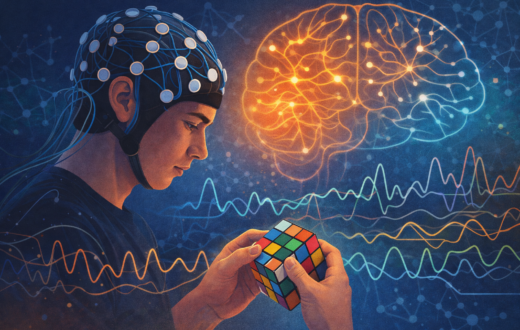
Development of Executive Functions. The process of assembling the Cube activates the prefrontal cortex, which is responsible for planning and decision-making. The learner must retain multiple sequences of actions in memory, predict the outcomes of manipulations, and adjust strategy according to the current situation. This fosters the capacity for voluntary behavioral regulation, which is essential for successful learning.
Stress-Reducing Effect. Manipulation of the Cube has a calming effect on the nervous system, comparable to the known effect of fidget spinners. However, unlike passive rotational movement, working with the Cube requires cognitive engagement, promoting conscious self-regulation.
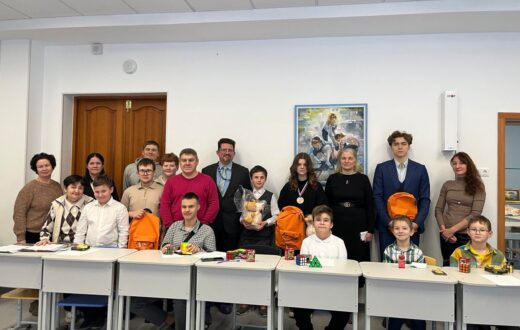
Enhancement of Self-Esteem. Achievement of a result – assembling one side, two layers, or the complete puzzle – is accompanied by strong positive reinforcement. Practical experience has demonstrated that even partial success (in a group of 15 children, 2 learned to assemble the entire Cube, 1 learned to assemble two layers, and 2 learned to assemble one side) significantly increased children’s confidence in their abilities.
Sensorimotor Integration. For children with visual impairments, the Rubik’s Cube develops compensatory abilities through tactile perception. Study of tactile markings (circles, triangles, dots) facilitates the formation of an adequate object representation and develops fine motor skills, which positively influences speech quality (the motor and speech centers of the brain are anatomically proximate).
The effectiveness of Rubik’s Cube application depends on the degree of individualization of instruction (the “hand-in-hand” method), the gradual increase in task complexity, adequate motivational support, and competitive elements that stimulate interest. However, it can be concluded that the Rubik’s Cube is a sufficiently universal tool that promotes the development of voluntary regulation, emotional stability, and self-esteem regardless of the presence of physical limitations in learners.