

Why Does Pain Hurt Some People More Than Others? How Personality Tunes Our “Pain System”
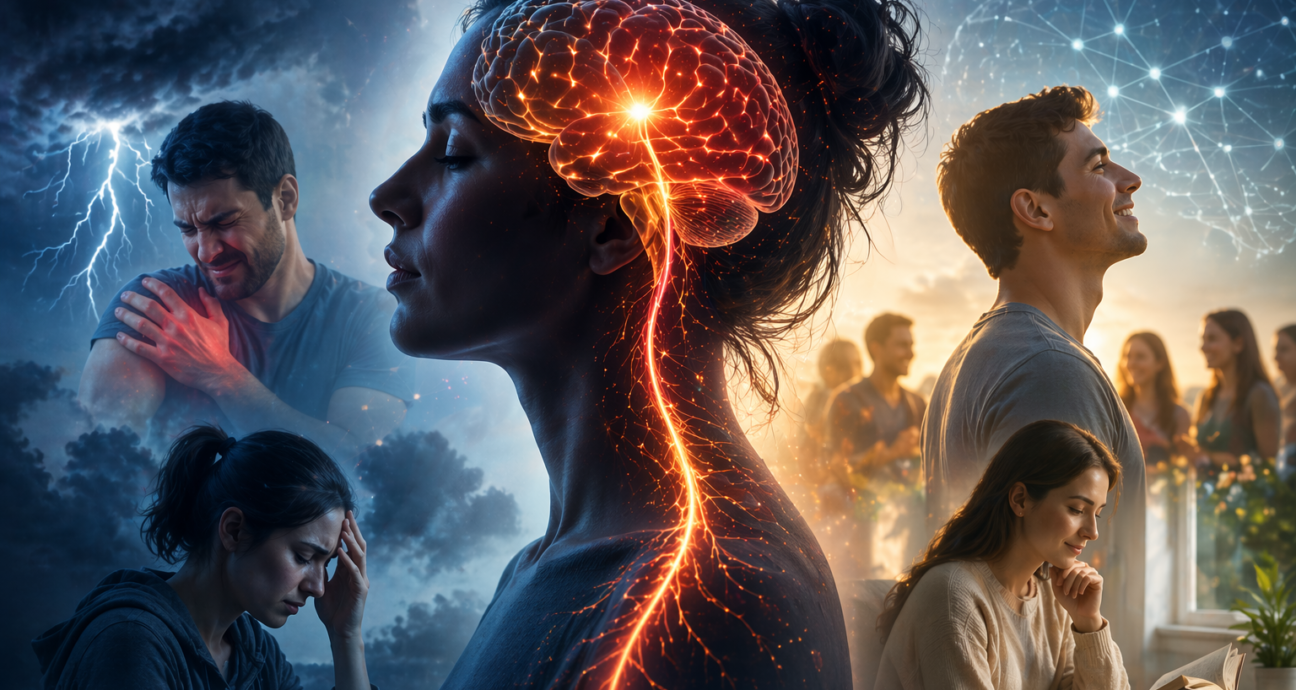
Have you ever noticed that one person can take an injection in stride, while another flinches at the slightest touch? Science confirms that the explanation lies not only in physiology — our personality traits literally calibrate the way the brain processes pain signals.
Neuroticism: A Pain Amplifier
The best-studied link is the one between neuroticism — a tendency towards anxiety and negative emotions — and increased pain sensitivity. A study by Banožić and colleagues (2018), published in the Korean Journal of Pain, showed that people with higher levels of neuroticism tend to have a lower pain threshold and poorer pain tolerance. The key mechanism is pain catastrophizing: the tendency to exaggerate the threat posed by a painful stimulus, mentally escalating it to the level of a catastrophe. Catastrophizing acts as a mediator — it is through this process that neuroticism exerts its influence on pain perception.
Extraversion: An Unexpected Twist
One might assume that sociable and upbeat extraverts would cope with pain more easily. However, a study by Grouper, Eisenberg, and Pud (2021), published in the Journal of Pain Research, found a paradoxical pattern: extraverts were more likely to fall into the group with high pain sensitivity. The researchers suggest that because extraverts are strongly oriented towards positive stimuli, they may be less resilient in the face of unexpected threat, which can intensify their negative response when pain occurs.
Conscientiousness and Openness: Protective Resources
Not all personality traits work against us. A review published in the journal Life (2025) indicates that conscientiousness — self-discipline and organization — helps people adhere more effectively to pain-management recommendations and reduces stress reactivity. Openness to experience, in turn, is associated with a more adaptive response to novel painful sensations: curiosity takes the place of fear.
What Does This Mean in Practice?
Understanding the link between personality and pain opens the door to personalized pain medicine. If a physician knows that a patient is prone to neuroticism and catastrophizing, they can proactively offer cognitive-behavioral techniques to reduce anxiety rather than simply increasing the dose of an analgesic. Our character is not a life sentence, but it is an important variable in the equation of pain — and one that deserves consideration.